Funny Video Boy Adding 5 Traces His Hand Hand
Many researchers have proved that kids learn better and faster if they actively engage themselves with the math they are learning. Learning through textbooks or flash cards do not provide the required level of active learning. Math games have the ability to put kids' mind on higher active mode. The math games provide an atmosphere where kids can:

- think, discuss and share their ideas with others
- develop the confidence to speak their minds
- work cooperatively
- develop curiosity and interest in math
- gain confidence to solve math problems in the real world
One important advantage of learning math through games is that it provides an immediate assessment to the student, teacher, and parents. The game format enables the teachers and the parents to evaluate the problem solving strategies adopted by kids while playing.
Math games strengthen the understanding of kids who are already good at Math and provide support to the kids who are in need. Math games teach skills consistent with the school curriculum along with the skills that the formal education sometimes miss out – the skills of enjoying math while thinking hard.
Overview of Math Topics
The table below displays the common core math standards along with the grades.
| Domains | Grade Level |
| Counting & Cardinality | K only |
| Operations & Algebraic Thinking | K – 5 |
| Numbers & Operations in Base Ten | K – 5 |
| Number & Operations - Fractions | 3 – 5 |
| Measurement & Data | K – 5 |
| Geometry | K – 5 |
Counting & Cardinality
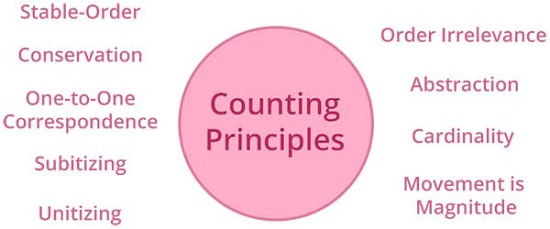
When kids enter kindergarten, they have very limited experience with numbers. Some may be able to count to 10 and some may count to 100. Kids at kindergarten are first taught about one-to-one correspondence where they connect one number with one object and then count them with understanding. They then make their way to understand cardinality, i.e., tell how many are there in a set. By the end of kindergarten, kids know the sequence (up to 100) and number names (up to 20). They are able to count the number of objects in small sets (up to 20) and also learn to compare them.
Operations & Algebraic Thinking
- Kindergarten: After understanding cardinality, the concept of addition and subtraction is introduced. The kids understand addition as putting together and adding to and understand subtraction as taking apart and taking from. This concept is taught using objects, drawings, manipulative like counters or through math games. By the end of kindergarten, the kids are able to add or subtract within 10.

- Grade 1: At this stage, kids are taught to represent and solve addition and subtraction word problems within 20. They understand the relationship between addition and subtraction. They also work with addition and subtraction equation to find the missing whole number in the equation.
- Grade 2: By this grade level, the kids are able to fluently add and subtract within 20 using mental math strategies. They also develop skills to add and subtract within 100 and solve one and two steps word problems. The kids also work with equal groups of objects which help them gain foundations for math multiplication.
- Grade 3: In this grade, the kids are expected to represent and solve problems involving multiplication and division within 100. They learn the properties of multiplication and relationship between multiplication and division. By the end of grade 3, the kids are able to solve problems involving the four operations and identify and explain patterns in arithmetic operations.
- Grade 4: In this grade, kids are expected to solve multi-step math word problems involving whole numbers using the four operations. They also gain familiarity with factors and multiples, prime and composite numbers.
- Grade 5: At this level, kids learn to evaluate whole number numerical expressions using the order of operations. They also develop skills to analyze math patterns and relationship between corresponding terms of the patterns.
Numbers & Operations in Base Ten
- Kindergarten: The kids learn how to compose and decompose numbers into tens and ones from 11 to 19.
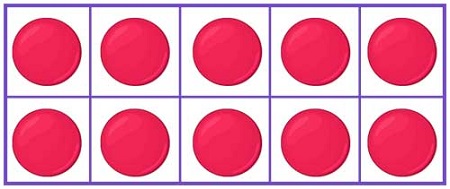
- Grade 1: In this grade, kids learn to count to 120, starting from any number less than 120. They understand place value system and are able to compare two-digit numbers based on the meaning of tens and ones digits. They are taught to add/subtract the multiples to 10 in the range 10-90.
- Grade 2: The kids, at this grade level, are introduced hundreds, tens, and ones of the three-digit numbers. They are also taught to read and write numbers to 1000 in expanded form and number names using base ten numerals and compare them. They use their place value understanding to fluently add or subtract within 1000. Also, they develop skills to add up to four two digit numbers.
- Grade 3: In this grade, kids make use of place value understanding to fluently add and subtract within 1000 and round whole number to nearest 10 or 100. They are also taught to multiply one-digit whole numbers by multiples of 10 in the range 10-90.
- Grade 4: In this grade, kids recognize that in a multi-digit whole number, a digit in a place represents 10 times the digit to its left. They are able to read and write multi-digit numbers, their expanded form and number names. They use their understanding of place value system and properties of operations to perform multi-digit arithmetic. Also, they develop a skill to perform multiplication up to four digits by a one-digit and multiply two-digit by two-digit. Besides this, they are taught division with quotients and remainders up to four-digit dividends and one-digit divisors.
- Grade 5: This grade calls for the introduction of decimal numbers. Kids are taught to read, write and compare decimals to thousandths. They are also taught to perform operations with multi-digit whole numbers and with decimals to hundredths.
Number & Operations – Fractions
- Grade 3: Fractions are introduced at this grade level. The kids develop an understanding of fractions as numbers. They learn the representation of fraction on the number line. They learn about the concept of equivalent fractions and comparing fractions with the same numerator or same denominator.
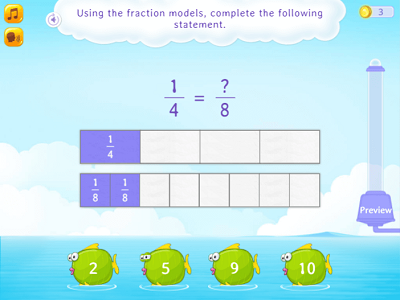
- Grade 4: In this grade, kids extend their understanding of fraction equivalence and ordering. They are able to compare fractions with different numerator and different denominators. They also learn decomposition of fractions along with addition, subtraction, and multiplication of fractions and mixed numbers. Kids are also taught decimal notation for fractions and comparing decimal numbers.
- Grade 5: Kids, in this grade, are taught addition and subtraction of fractions by making them equivalent fractions. The kids are expected to extend their previous understanding of multiplication and division to multiply fractions with fractions or whole numbers. They also interpret multiplication as scaling and are able to solve real world problems involving multiplication of fractions and mixed numbers. They apply a previous understanding of division to divide whole numbers and unit fractions.
Measurement & Data
- Kindergarten: This grade level focuses on teaching measurable attributes such as weight and length. The kids learn to compare two objects with common measurable attributes.
- Grade 1: The kids, in this grade, learn to measure length indirectly and by iterating length units. They are able to tell and write time in hours and half hours using analog and digital clocks. They are also expected to organize, represent and interpret data with questions like how many total, how many in each category or how many less or more.
- Grade 2: This grade introduces the standard units of measurement like inches, feet, centimeters, and meters. They are expected to measure and estimate the length of objects in standard units. They relate addition and subtraction to length and work with time and money. They are introduced with line plot, picture graph, and bar graph.
- Grade 3: The kids, at this grade, are expected to tell and write time to the nearest minute and measure time intervals in minutes and also solve word problems on this basis. They are introduced the standard unit of capacity and masses like grams, kilograms, and liters. The kids also learn to draw a scaled picture graph and scaled bar graph, generate measurement data by measuring length. They understand the concept of area and relate area to multiplication and addition. The kids also solve real world problems involving perimeters of polygons.

- Grade 4: The kids, at this grade level, relate sizes of measurement units within one system of units. They use the four operations to solve word problems involving intervals of time, distances, masses of objects, money and liquid volumes. They also learn to apply area and perimeter for rectangles in the real world. Under geometric measurement, they understand concepts of angles and measure angles in whole number degrees using a protractor.
- Grade 5: In this grade, kids are taught to convert different-sized measurement units within a given measurement system and use these units to solve word problems. Under geometric measurement, they are taught about the concept of volumes.
Geometry
- Kindergarten: The kids, in this grade, describe objects using names of shapes and also identify and analyze shape as two-dimensional or three-dimensional.
- Grade 1: The kids, at this level, distinguish between defining attributes and non-defining attributes of shapes. They are taught to partition circles and rectangles into two and four equal shares.
- Grade 2: The kids are able to recognize and draw shapes according to the number of angles or number of faces. Partition circles and rectangles into two, three or four equal shares. They identify triangles, quadrilaterals, pentagons, hexagons, and cubes.

- Grade 3: The kids recognize squares, rhombuses, and rectangles as quadrilaterals. They are able to differentiate between quadrilaterals and shapes that are not quadrilaterals. They are also able to partition shapes into equal parts.
- Grade 4: The kids are expected to draw and identify lines and angles, and classify shapes by their properties. They are also taught to identify line-symmetric figures and draw lines of symmetry.
- Grade 5: The kids are taught to graph points on the coordinate plane to solve real world problems. They classify two-dimensional figures in a hierarchy based on properties.
Math games From SplashLearn
SplashLearn is one of the pioneers in the education system providing a well-designed learning material as per common core math standards and most of the state standards. Some of the attractive features of SplashLearn are:
- Play on any device: The kids can play SplashLearn games on the device of their choice; iPad, laptop, iPod etc.
- Engaging and rewarding games: The kids jump up with excitement when they realize they can buy their favorite animated pet from the coins earned through practice.
- Parent Connect App: The parents can get instant notifications on progress improvement and skill completion through their app.
- Offline access: SplashLearn games can also be played offline through their app.
These are only a few features that make SplashLearn attractive, there are many other reasons to choose SplashLearn for making math learning fun.
humphreyshopplaunt72.blogspot.com
Source: https://www.splashlearn.com/math-games

Post a Comment for "Funny Video Boy Adding 5 Traces His Hand Hand"